

The Key Takeaways: Deep neck flexor exercises, chin tucks, head lifts, isometric holds, and resisted flexion training, build the longus colli, longus capitis, and rectus capitis muscles that stabilize the cervical spine, typically over 6 or more weeks.
Most people who slouch over a laptop all day never train these muscles directly, because they sit deep in the front of the neck where you can’t see or feel them working. That’s also why weakness here shows up as posture fatigue and a forward-carried head long before it shows up as anything you’d notice on purpose.
What are the deep neck flexors?
The deep neck flexors are a group of four muscles running along the front of the cervical spine, tucked behind the trachea and esophagus, well underneath the more visible sternocleidomastoid and scalenes:
- Longus colli runs from the upper thoracic vertebrae to the atlas (C1) along the front of the cervical spine. It flexes the neck forward and assists a slight rotation to the opposite side.
- Longus capitis starts at the transverse processes of the mid-cervical vertebrae and attaches to the base of the skull. It flexes the head and neck, the motion of bringing your chin toward your chest.
- Rectus capitis anterior is a short muscle from the atlas to the base of the skull that assists head flexion at the joint just below the skull.
- Rectus capitis lateralis also runs from the atlas, helping stabilize the head and control side-bending.

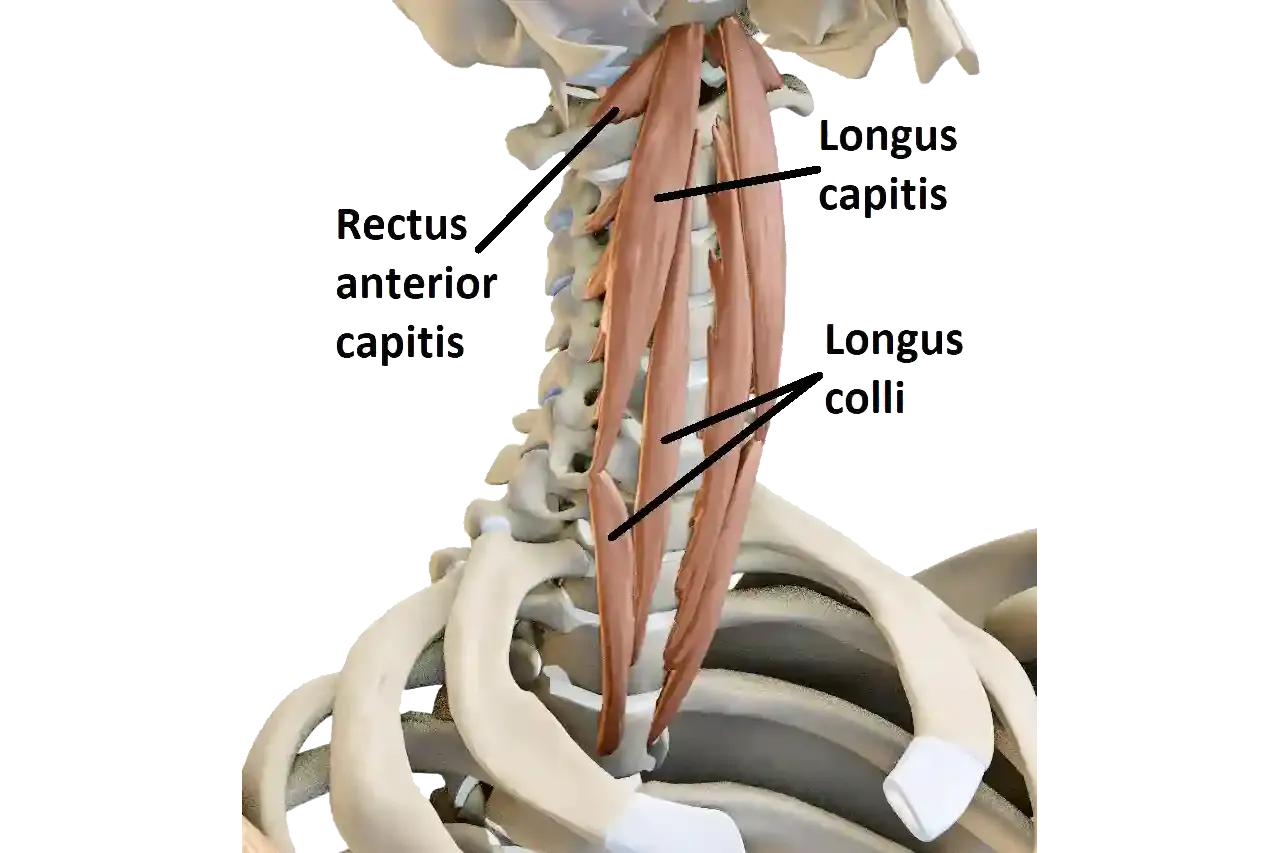
The four deep neck flexors sit close to the spine itself, distinct from the larger, more visible muscles at the front and sides of the neck.
Small as they are, these four muscles do outsized work: they stabilize the cervical vertebrae, control forward flexion (nodding, looking down to read or eat), and hold the head’s weight without over-relying on the more superficial neck muscles.
Why does deep neck flexor strength matter for posture?
When the deep flexors are weak, the bdy doesn’t stop moving the head. It compensates by leaning more on the superficial flexors, the muscles that sit closer to the surface and aren’t built for sustained postural work. Over time, that substitution shows up in a few consistent ways.
Weak deep flexors are associated with forward head posture, where the head sits ahead of the shoulders instead of stacked above them, and with the day-to-day posture fatigue and neck tension that comes from asking the wrong muscles to do a stabilizing job. Research using the craniocervical flexion test has found that people with ongoing neck tension tend to recruit the deep flexors less and the superficial flexors more during controlled neck movement, compared to people without neck symptoms.1
How do you test deep neck flexor strength?
The two most-used assessments come from physical therapy research and are simple enough to try at home as a rough benchmark, not a diagnosis.
The craniocervical flexion test
Developed by Gwendolen Jull and colleagues, the craniocervical flexion test (CCFT) uses a pressure sensor placed behind the neck while lying down, and asks you to perform five progressively deeper nodding motions while keeping the superficial muscles as quiet as possible.1 It’s the standard clinical and research method for measuring deep flexor activation quality, not just raw strength.
The deep neck flexor endurance test
This one needs no equipment. Lie on your back with knees bent and feet flat, perform a chin tuck, lift your head slightly off the surface, and hold the position without letting your chin poke forward or your form break down. Time how long you can hold it.

A 2011 study of 126 healthy adults established normative hold times: an average of 38.9 seconds for men and 29.4 seconds for women, with women showing statistically shorter hold times across the sample.2 Those numbers are a reference point, not a pass/fail line. Losing form well before that mark just means there’s room to build endurance.
What are the best deep neck flexor exercises?
These four build on each other, from bodyweight activation to resisted training. Add resistance only once the bodyweight versions feel controlled, not shaky.
Chin tucks
Sit or stand upright. Pull the chin straight back, without tipping the head down, until you feel a mild “double chin” position. Hold for 5 seconds, and repeat 10 times. As it gets easier, extend the hold rather than rushing the reps.
Head lifts
Lie on your back with your knees bent. Perform a chin tuck, then lift your head a small amount off the floor, keeping the chin tucked the whole time. Hold for 5 seconds, repeat 10 times, and increase the hold duration gradually as it gets easier.
Isometric neck flexion
Place your palm flat against your forehead. Push your head forward into your hand without letting the head actually move; your hand provides the resistance. Hold for 5 seconds, repeat 10 times, and press a little harder as strength builds.
Resisted flexion with an adjustable trainer
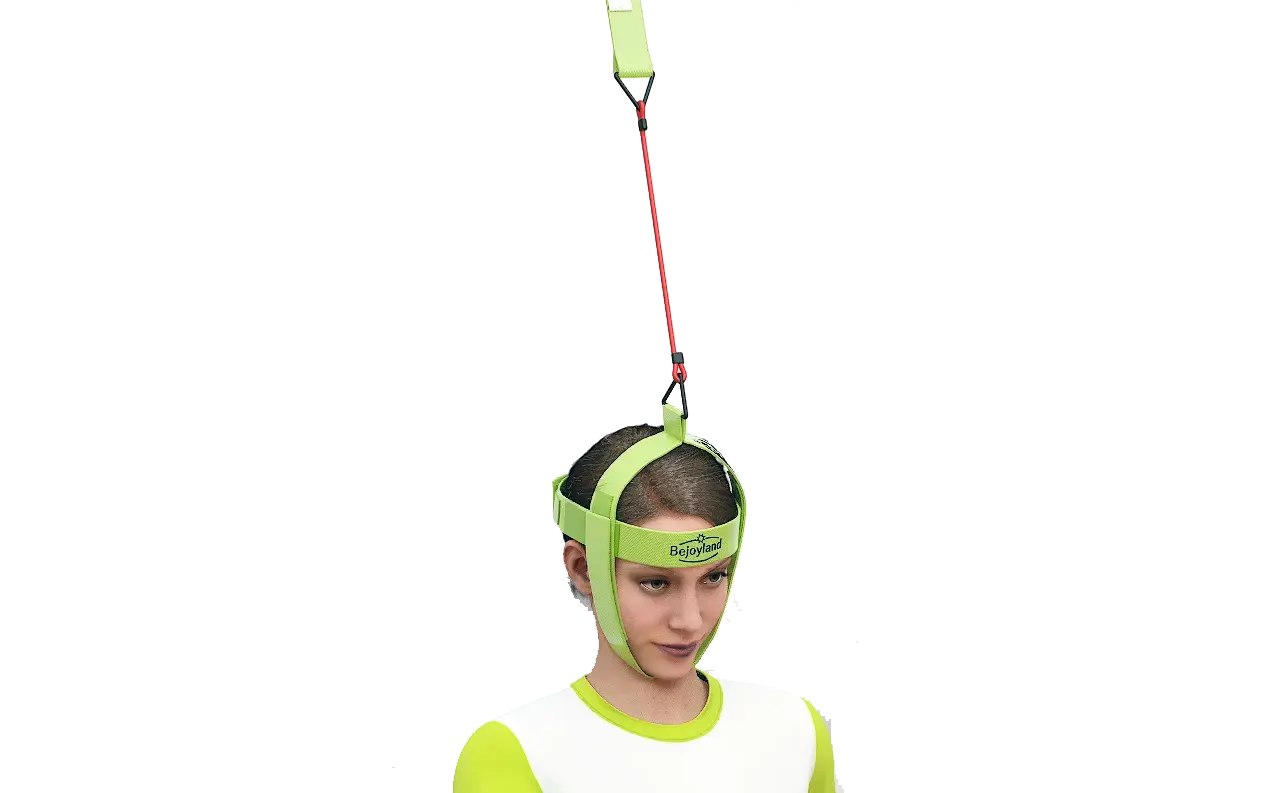
A tool with adjustable resistance, such as the Bejoyland NECKY, Bejoyland NECKY, lets you scale the training load and hold duration as your deep flexors get stronger, rather than being limited to bodyweight. The elastic resistance band works through all three contraction types (concentric, isometric, and eccentric) in one movement, which the manual bodyweight versions above can’t fully replicate on their own.
The main technique cue carries over from the bodyweight exercises: keep the superficial neck muscles as quiet as possible and let the deep flexors do the work, checking this by lightly touching the sides of your neck as you move. Because the trainer’s harness frees up your hands, you can palpate and self-correct while you train instead of needing a second person to check your form.
How long does it take to see results?
Deep flexor training research generally uses programs of 6 weeks or longer, done most days of the week, before measuring meaningful change in activation and endurance.3 Consistency beats intensity: five minutes of chin tucks and head lifts daily outperforms one long weekly session. Progress the hold time or resistance gradually, and back off if the superficial muscles at the front and sides of your neck start taking over the movement.
How do you do deep neck flexor exercises safely at home?
- 1. Test your baseline with the deep neck flexor endurance test before starting a routine.
- 2. Start with bodyweight chin tucks and head lifts, 10 reps of 5-second holds, once or twice daily.
- 3. Add isometric resistance with your palm once bodyweight holds feel stable and controlled.
- 4. Progress to an adjustable-resistance trainer once you can complete bodyweight and isometric sets without the superficial muscles taking over. the superficial muscles taking over.
- 5. Increase hold time or resistance gradually over 6 or more weeks, tracking whether your endurance test time improves.
NECKY and the exercises above are built for general fitness, strength-building, and posture support, not to diagnose or treat a medical condition. If you have a pre-existing cervical-spine condition, talk to a healthcare provider before starting a new neck-training routine.
FAQ
What are the deep neck flexor muscles?
They’re four muscles at the front of the cervical spine: longus colli, longus capitis, rectus capitis anterior, and rectus capitis lateralis. Together they stabilize the neck and control forward flexion of the head.
How long should you hold a chin tuck?
Start with 5-second holds for 10 repetitions, once or twice a day. Extend the hold time gradually as the position feels more stable, rather than rushing through more reps.
What's a normal deep neck flexor endurance time?
Normative data from a study of 126 healthy adults puts the average hold time at 38.9 seconds for men and 29.4 seconds for women.2 It’s a reference point for tracking your own progress, not a strict benchmark to hit.
Can weak deep neck flexors contribute to forward head posture?
Weak deep flexors are associated with forward head posture and with the superficial neck muscles compensating for postural support they aren’t built to provide long-term. Strengthening the deep flexors is one part of addressing that pattern.
How often should you do deep neck flexor exercises?
Most research protocols use daily or near-daily practice over 6 or more weeks. Short, frequent sessions (a few minutes, most days) tend to work better than occasional long ones.
Is it safe to add resistance to neck flexor exercises?
For most people building on a stable bodyweight foundation, yes, provided the resistance is adjustable and increased gradually. Anyone with a pre-existing cervical-spine condition should check with a healthcare provider before adding load.
Sources
- Jull G, O’Leary S, Falla D. Clinical assessment of the deep cervical flexor muscles: the craniocervical flexion test. Journal of Manipulative and Physiological Therapeutics, 2008. PubMed.
- Domenech MA, Sizer PS, Dedrick GS, McGalliard MK, Brismée JM. The deep neck flexor endurance test: normative data scores in healthy adults. PM&R, 2011. PubMed.
- Carmen Martin-Gomez, Rebeca Sestelo-Diaz, Victor Carrillo-Sanjuan, Marcos Jose Navarro-Santana, Judit Bardon-Romero, Gustavo Plaza-Manzano. Motor control using cranio-cervical flexion exercises versus other treatments for non-specific chronic neck pain: a systematic review and meta-analysis. Musculoskeletal Science and Practice, 2019. ScienceDirect.