

The Key Takeaways: Real deep neck flexor activation, when it has stopped engaging properly due to posture, muscle imbalance, inactivity, or a past neck injury, comes from relearning the pattern with low-load, palpation-checked cues: chin tucks, supine head nods, and biofeedback, rather than just adding resistance. Feeling the upper trapezius or sternocleidomastoid do the work instead is the most common failure mode, and the fix is resistance angled straight back rather than perpendicular to the spine.
If you’ve tried chin tucks and felt your traps or the muscles at the sides of your neck doing the work instead, that’s not a failed exercise. It’s the most common failure mode in deep flexor training, and it has a specific mechanical cause.
In This Article:
- Why don’t your deep neck flexors activate on their own?
- What happens when the superficial muscles take over?
- How do you achieve deep neck flexor activation without the superficial muscles taking over?
- Why does resistance direction matter for deep flexor training?
- How do you do a chin tuck with adjustable resistance?
- What should you keep in mind for effective training?
- FAQ
- Sources
Why don’t your deep neck flexors activate on their own?
The neck’s muscles are supposed to work as a team: deep flexors stabilize, superficial muscles move. When that division of labor breaks down, several things tend to be behind it.
- Poor posture, especially a forward head position, lengthens and weakens the deep flexors over time, which reduces how effectively they engage.
- Muscle imbalance lets the more dominant superficial muscles (upper trapezius, levator scapulae, sternocleidomastoid) take over movements the deep flexors should be doing.
- A sedentary lifestyle deconditions the deep flexors specifically, since they rarely get challenged during normal daily movement.
- A sudden neck injury, such as a car accident or a fall, can disrupt neuromuscular control of the deep flexors even after the injury itself has settled.
Most conventional neck-training tools make this worse rather than better: they pull the head backward, roughly perpendicular to the cervical spine, which is exactly the direction that recruits the superficial muscles first.
What happens when the superficial muscles take over?
Once the superficial muscles are doing a stabilizing job they weren’t built for, three patterns tend to show up together: cervical strain and tension from muscles like the upper trapezius working overtime, postural deviations such as forward head posture that worsen as the imbalance continues, and reduced structural support, since the deep flexors are what’s supposed to stabilize the cervical spine, and their under-activity shifts load onto everything around them.How do you achieve deep neck flexor activation without the superficial muscles taking over?
Four approaches, in order of how much control they give you over what’s actually happening under your skin.Chin tuck
Lie on your back with your head supported. Slowly retract your chin, creating a mild double-chin effect, without lifting your head off the surface. The goal is minimal activation of the muscles at the front and sides of your neck while the chin moves.Head nod in supine position
Once the chin tuck feels controlled, add a subtle nodding motion while lying down, as if gently agreeing, keeping the focus on the muscles at the very front of the neck rather than the ones you can easily feel tense up.Biofeedback training
A pressure biofeedback unit (a small air-filled sensor placed behind the neck) gives real-time feedback on activation quality. Research on this method has found that superficial flexor activity, in the sternocleidomastoid and scalenes, changes measurably depending on how the exercise is set up, which is part of why biofeedback and self-monitoring matter more here than in most exercises.2Manual palpation
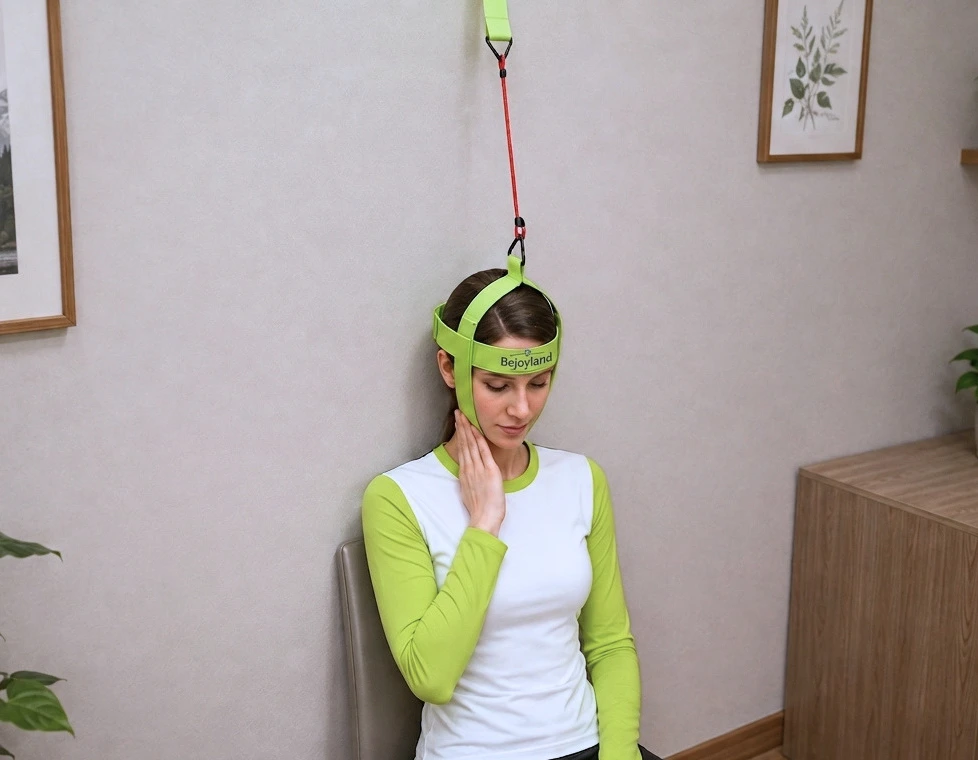
Lightly touch the sides of your neck, over the sternocleidomastoid, while you perform the movement. If you feel that muscle bulk up and tense during a chin tuck, the superficial muscles are compensating; a clean rep should leave it comparatively quiet. It’s also the one technique you can do entirely on your own, without a therapist or a sensor, which is why a tool that leaves your hands free to check yourself as you train has a clear edge here.Why does resistance direction matter for deep flexor training?
Most exercise equipment pulls the head straight back, at close to a right angle to the cervical spine. That direction of pull is mechanically suited to the superficial muscles, so it recruits them by default, which is exactly the substitution problem this article is about. The Bejoyland NECKY‘s elastic resistance band is set up differently: the pull runs along the axis of the cervical spine itself, not across it. That single design choice is why it doesn’t trigger the same superficial takeover that a backward-pulling device does, and it’s also why the harness leaves your hands completely free, since nothing needs to be braced against a backward pull. You get to palpate the sternocleidomastoid and check your own form in real time, the same manual technique described above, without needing a second person or a clinical sensor.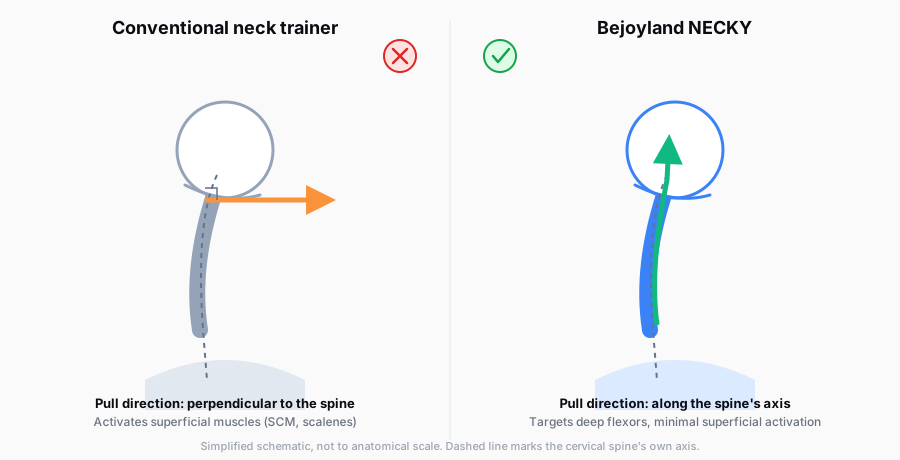
How do you do a chin tuck with adjustable resistance?
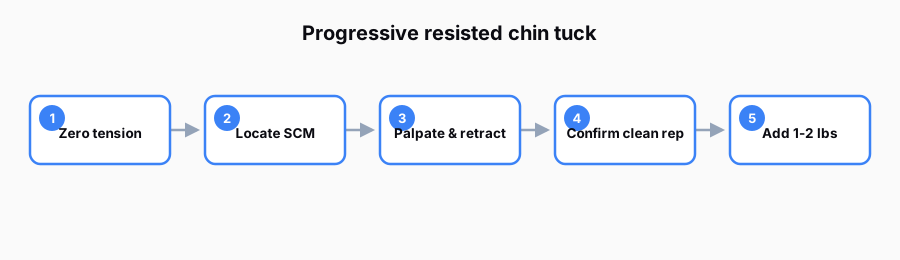
Once the bodyweight version of the chin tuck feels controlled, here’s how to bring in progressive resistance without losing that control:- Set the elastic cord tension to zero before you start.
- Turn your head slightly left and right to find where the sternocleidomastoid attaches near the collarbone; it’s easiest to feel at the extreme of the turn.
- Rest a finger or two on that attachment point on one side so you can monitor its activity as you move.
- Slowly retract your chin at zero load, keeping that muscle as relaxed as you can under your fingers, and hold.
- Once the movement is clean and controlled at zero resistance, increase the band tension by 1-2 lbs and repeat, still checking by palpation that the superficial muscles stay quiet.
The same zero-load-first approach works for the head nod: once chin retraction is controlled at a given resistance, add a gradual forward head tilt, letting the movement travel down through the cervical spine segment by segment, then return to the tucked starting position. Keep monitoring the superficial muscles by palpation the whole time, and only add resistance once the lower level feels stable, not just tolerable.
What should you keep in mind for effective training?
Form matters more than load here. A technically clean rep at zero resistance builds the right pattern; a resisted rep with the superficial muscles compensating just reinforces the wrong one. Progress gradually, since the whole point of training in a 0-10 lb range is that you can find the smallest increase that still challenges the deep flexors without inviting the superficial muscles back in. And be consistent: this is a neuromuscular retraining problem as much as a strength one, so a few minutes most days beats one long session a week.
NECKY and the exercises above are built for general fitness, activation, and strength-building, not to diagnose or treat a medical condition. If you have a pre-existing cervical-spine condition, talk to a healthcare provider before starting a new neck-training routine.
FAQ
Why can't I feel my deep neck flexors working?
They sit deep in the front of the neck, well underneath the muscles you can easily feel, so you’re unlikely to notice them directly. If you feel your traps or the sides of your neck working instead during a chin tuck, that’s a sign the superficial muscles are compensating rather than the deep flexors doing the job.
What's the difference between a chin tuck and a head nod?
A chin tuck retracts the chin straight back without moving the head otherwise. A head nod builds on that retracted position with a small forward tilt of the head, engaging the deep flexors through a bit more range once the basic chin tuck is controlled.
How do you check if your superficial neck muscles are compensating?
Lightly touch the sternocleidomastoid at the side of your neck while you perform the movement. Noticeable tensing or bulging under your fingers means the superficial muscles are taking over; a clean rep keeps that muscle comparatively relaxed.
What is biofeedback training for the neck?
It typically uses a pressure sensor placed behind the neck to give real-time feedback on how well you’re activating the deep flexors versus the superficial muscles, which helps you self-correct during training rather than guessing at your form.
How much resistance should you start with for deep neck flexor activation?
Start at zero load and confirm the movement is clean by palpation first. Once that’s controlled, small increases (1-2 lbs at a time) keep deep neck flexor activation challenged without recruiting the superficial muscles back into the movement.
Can you activate deep neck flexors without any equipment?
Yes, for learning the pattern itself: chin tucks, head nods, and palpation need nothing but your own hands. Adding resistance without equipment is the hard part. Bracing your jaw against a fist gives you a counterforce, but the sternocleidomastoid rarely stays quiet in that setup, and there’s no way to gauge or adjust how hard you’re pushing. An adjustable-resistance trainer like the Bejoyland NECKY pulls the chin along the same upward line as the drill itself, which keeps the superficial muscles out of the movement and lets you dial resistance up in small, measurable increments instead of guessing.
Sources
- Kashfi P, Karimi N, Peolsson A, Rahnama L. The effects of deep neck muscle-specific training versus general exercises on deep neck muscle thickness, pain and disability in patients with chronic non-specific neck pain: protocol for a randomized clinical trial (RCT). BMC Musculoskeletal Disorders, 2019. PubMed.
- Yang JM, Cha HG, Kim MK. Effects of manipulation of the thorax and intensity of the pressure biofeedback unit on the superficial cervical flexors muscle during craniocervical flexion exercise. Journal of Physical Therapy Science, 2017. PMC.
- Jull G, O’Leary S, Falla D. Clinical assessment of the deep cervical flexor muscles: the craniocervical flexion test. Journal of Manipulative and Physiological Therapeutics, 2008. PubMed.
- Physiopedia. Deep Neck Flexor Stabilisation Protocol. Physiopedia.